HGCPosts

Changing Course Without Sinking the Ship: How High-Growth CEOs Navigate AI Transformation

This post is part of our continuing series examining the Ten CEO Roles Framework® through...

A High-Growth CEO Perspective on the Transition to an AI Native Company

This post is part of our blog series examining the Ten CEO Roles through the...

The Race Towards AI Adoption. What Kind of “AI CEO Captain” Are You? Why Does it Matter?

Navigating AI requires close attention to FOUR of our TEN CEO Roles: Deliver Winning, Innovative...

How Successful CEOs Lead Today: The Ten Roles That Drive Alignment, Execution, and Sustainable Growth

The CEO role has always been demanding, but the expectations of today's leaders are fundamentally...

CEO Outlook 2025: Navigating Today’s Economic Climate with Resilience and Agility

CEOs currently need to lead through a lot of chaos and confusion. Rising costs, slower...

This post is part of our continuing series examining the Ten CEO Roles Framework® through 30 years of experience advising investor backed technology CEOs. Our High-Growth CEO Forum® (HGCF) members and coaching clients, often working with us for years from leading early stage startups through $100M+ ARR growth, have generated over $20B+ in exit value through IPOs and M&A. They frequently credit their long-term participation in our services as material to their successful outcomes.
Fresh from our Q3 2026 HGCF quarterly sessions, this series illuminates the pressures and rapid transformation requirements characterizing today’s turbulent tech ecosystem.

Steering Through the AI Sea-Change

All know that the entire technology ecosystem is undergoing a massive sea-change. AI is no longer a distant horizon or a marketing embellishment: it is a fundamental force reshaping software value, customer expectations, and enterprise valuations.

For those software companies with revenue, customers and products developed in the pre-AI era the core leadership challenge now is how do you change course without sinking the ship?  Assumptions about fundability, growth trajectories, product value that seemed solid just a year ago are totally upended.

Right now, across both venture-backed scale-ups and private equity portfolio companies, the single greatest operational hazard CEOs face is The Double Flat-Line Dilemma:

“How do you overhaul your core technology, re-tool your executive team, and pivot to an AI-native model while ensuring the existing revenue engine stays afloat to keep the lights on?”

Capital markets have frozen for many.  Investors are funding AI-ready platforms. Yet, if you steer too aggressively into a ground-up AI-Native rebuild, feature delivery for your current enterprise clients stalls, key accounts churn out the back door, and revenue flat-lines. Conversely, if you hold your legacy course and do nothing, emerging AI capabilities risk rendering your core technology obsolete and your funding future dismal.


The 5 Transformation Pressures Facing High-Growth CEOs

Inside our High-Growth CEO Forum sessions, leaders have always tackled the unvarnished realities of steering through market turbulence. Across our forum cohorts this quarter, five core transformation pressure points emerged as defining priorities for growth stage CEOs. We will expand on each of these topics in subsequent blog posts.

  • AI Turbulence and Core SaaS Defense
    Executive teams must protect existing software ARR while building next generation AI capabilities. Leading CEOs establish parallel AI squads to innovate without disrupting their core revenue engine.
  • Architecture and Moat Protection
    As interface workflows become commoditized, companies anchor defensibility in proprietary data, enterprise integrations, and technical specialists embedded directly into key accounts.
  • Seat Cap Friction and Monetization
    Productivity gains are driving enterprise buyers to manage workloads with fewer seats. CEOs are moving to hybrid floor and ramp consumption models to align pricing with actual value delivered.
  • Executive Talent Alignment and Velocity
    Scaling past revenue inflection points reveals stage mismatches in leadership. CEOs replace vague mandates with structured 30 60 90 day scorecards to build executive team velocity.
  • Board Governance in Choppy Waters
    Maintaining forecast credibility with PE and VC boards requires proactive alignment. CEOs implement no surprises pre board syncs to build trust and cash flow discipline.

Re-Rigging the Vessel While Under Way

To successfully chart a course through AI turbulence, High-Growth CEOs must learn to re-rig the vessel while under way. You cannot simply burn the ships that generate your current ARR, nor can you ignore the storm ahead. Successful leadership requires disciplined, dual-track execution: protecting the legacy core while pioneering the new AI-native future.


CEO Diagnostic Checklist

Before setting your strategic roadmap for the upcoming quarter, reflect on these four questions with your leadership team:

  1. Are we protecting the core revenue stream that keeps our vessel afloat while simultaneously deploying dedicated resources toward AI transformation?
  2. Is our engineering team trapped in legacy platform maintenance, or have we established a parallel squad to build next-generation capabilities?
  3. How are enterprise productivity gains impacting our customer seat counts, and is our pricing model built to capture usage-based expansion?
  4. Are we maintaining clear, transparent communication with our board regarding the timeline and capital required for our transformation?

How is your executive team balancing the need to preserve current ARR with the imperative to transform for an AI-native future? What adjustments have been most critical in keeping your course steady?


Connect With Us…

To learn how we support CEOs directly and through investor portfolio services:

  • High-Growth CEO Forum®
  • High-Growth CEO Coaching™
  • Planning for Growth™ — Building the Profit Spiral®
  • Building the Executive Team as Leaders of Growth®
  • CEO Workshops
  • Investor & Incubator Programs/Workshops

Visit High-Growth CEO to learn more.


Explore the Series

As this series unfolds, we will publish in-depth guides covering each of the 5 core transformation areas:

  • AI Transformation: A high-level overview of how executive teams protect core software revenue while building next-generation AI capabilities.
  • Executive Alignment: A look into how leaders scale their executive teams, upgrade key roles, and build organizational velocity during major growth transitions.
  • Pricing and Account Retention: An examination of modern GTM models, shifting away from seat-based pricing to defend retention and align with customer usage.
  • Investor Alignment: Insights on managing board expectations, maintaining forecast credibility, and aligning with PE and VC sponsors during periods of change.
  • Strategic Focus: A guide to eliminating initiative fatigue, simplifying priorities, and aligning the entire company around key growth drivers.

This post is part of our blog series examining the Ten CEO Roles through the lens of 30 years of experience working with high-tech, high-growth, investor-backed CEOs. Each post brings timely insights from our High-Growth CEO Forums®, Building the Profit Spiral® planning processes, CEO coaching and community conversations. Our previous post explored how leaders can bridge the gap between a personal CEO decision and organizational momentum. This post explores aspects of full AI-native transformation required to capture a premium valuation and build your competitive moat.

In a recent HGCEO cross-community online session, long-time member Gary Ambrosino, CEO of Ready Education, generously shared his ongoing experience and insights as he leads his company through an AI-native transformation. Regardless of where they sit on the AI adoption curve, our participating CEOs found immediate and actionable value in Gary’s insights.

What follows are examples of ongoing steps critical to make the transformation and takeaways from participants leaders must take to get there.  Thank you again Gary Ambrosino!


1. The CEO Must Lead the Transformation

  • The mandate to transition to AI cannot be delegated to your CTO. You must lead your team and your board through a series of strategic decisions that will fundamentally alter your value proposition, profitability, and valuation.
  • Your board and your executive team will often lack the in-depth knowledge required to advise you correctly on generative AI strategy.
  • Private equity investors may not know what to do, and venture capital investors simply want fast decision making. Waiting for consensus is not an option.
  • You must acquire a deep understanding of generative systems so you can make rapid decisions and lead from the front.


2. Valuation Follows AI Maturity

  • Buyers and investors are actively waiting for an AI unlock, and traditional SaaS company valuations are taking a hit. 
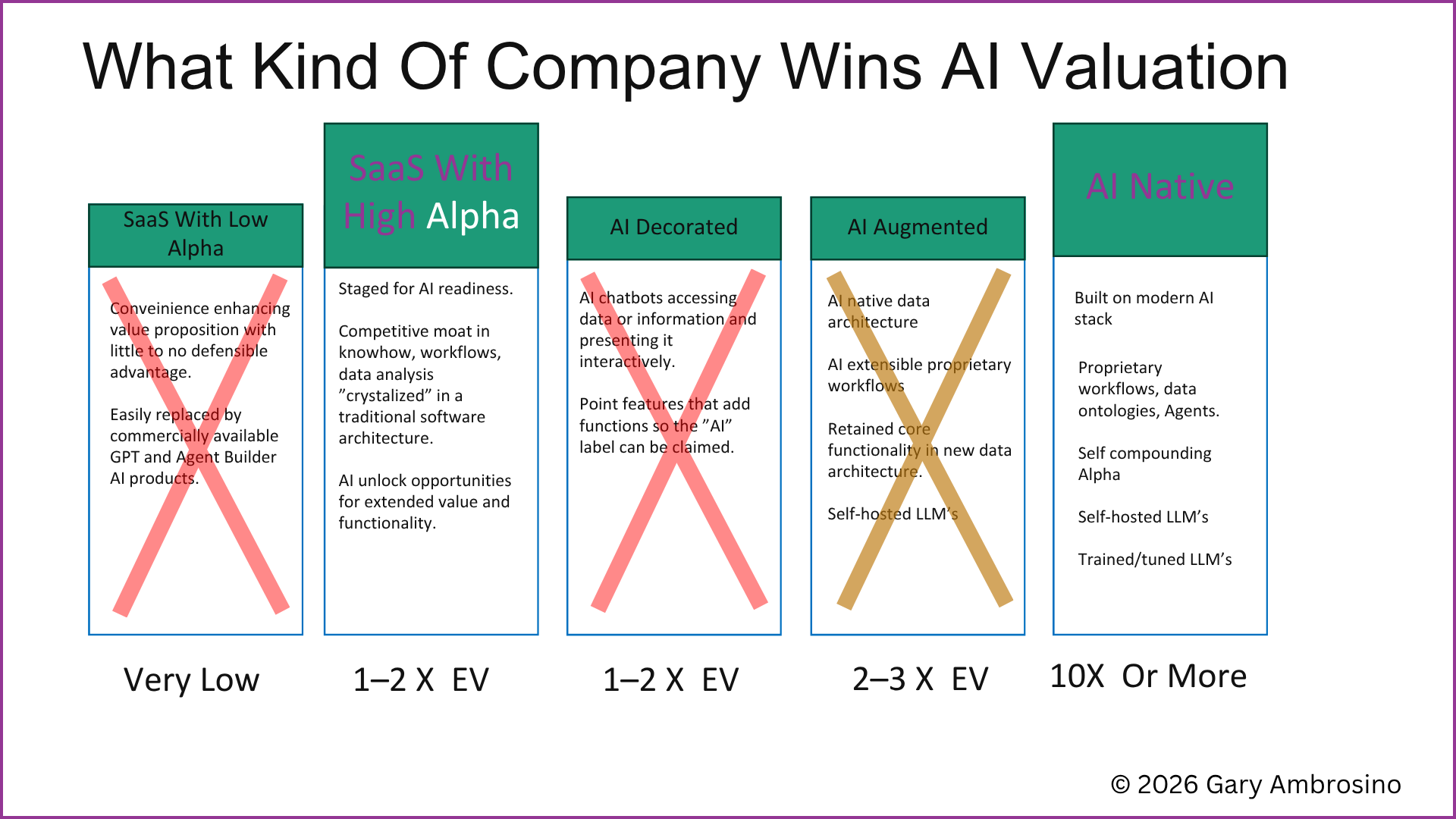
  • There are five levels of AI readiness, ranging from easily replaceable SaaS with low Alpha to fully AI-Native platforms. 
  • The difference in enterprise value between these tiers is massive. 
  • Companies that are merely “AI-Decorated” by adding a chatbot on top of old architecture might see a 1x to 2x revenue multiple, while true AI-Native companies built on modern AI stacks can command a 10x enterprise value.


3. Your AI Alpha Is Your Moat

  • The critical value question is not whether you are using AI to streamline basic operations. It is whether your AI strategy is built around what is unique about your company – this is your “AI Alpha.”
  • For a SaaS vendor, Alpha lives in the proprietary workflows, data signals, and processing rules refined through years of real customer usage and crystallized into your product structure.
  • AI is compelling because it unlocks this existing Alpha on an accelerated basis to add capabilities that were impossible before.
  • Encoding your Alpha into data sets, machine learning algorithms, and proprietary agents is the only thing competitors cannot replicate.


4. Understand Your Tokenomics and Take Action

  • Relying entirely on commercial hyperscaler platforms like OpenAI or Anthropic for your core product features creates a variable cost structure that can severely constrain your financial performance and erode gross margins. 
  • Gary uses the term “Tokenomics” to describe the critical management of these AI processing costs. 
  • By transitioning core workloads to self-hosted, open-weight models like Google Gemma on their own hardware, Ready Education was able to move from a variable, high cost of goods sold to a fixed SaaS annual subscription model, securing a 92.8 percent gross margin compared to just 14 percent on commercial APIs.


5. Incremental Updates Will Not Work

  • A real AI-native transformation requires a full re-platforming of the product, a complete culture shift to make operations “AI Fluid,” and a structured plan to sustain revenue growth during the transition. 
  • Modest, incremental updates are insufficient. 
  • To fund this transition at Ready Education, Gary ensured the company had the dedicated capital required to rebuild its data architecture from the ground up.


6. New Talent, Skills, and Learning Are Required

  • You must intentionally seed AI knowledge into your team. Gary introduced two critical new roles to ensure adoption moved safely and at speed. 
  • He hired an “AI Alchemist” who reports directly to the CEO, advising on strategic tech selection and building internal platforms. 
  • He also appointed a “Data Analyst” who controls and authenticates all data feeds, ensuring employees have a single, safe source of truth when building AI applications. 
  • Additionally, every employee is equipped with AI suites, and the entire engineering team is mandated to use Claude Code.


7. Re-Organize for Speed and Customer Responsiveness 

  • Traditional hierarchical structures move too slowly for the pace of AI innovation. 
  • Companies must flatten their organizations and reorganize for speed and communication. 
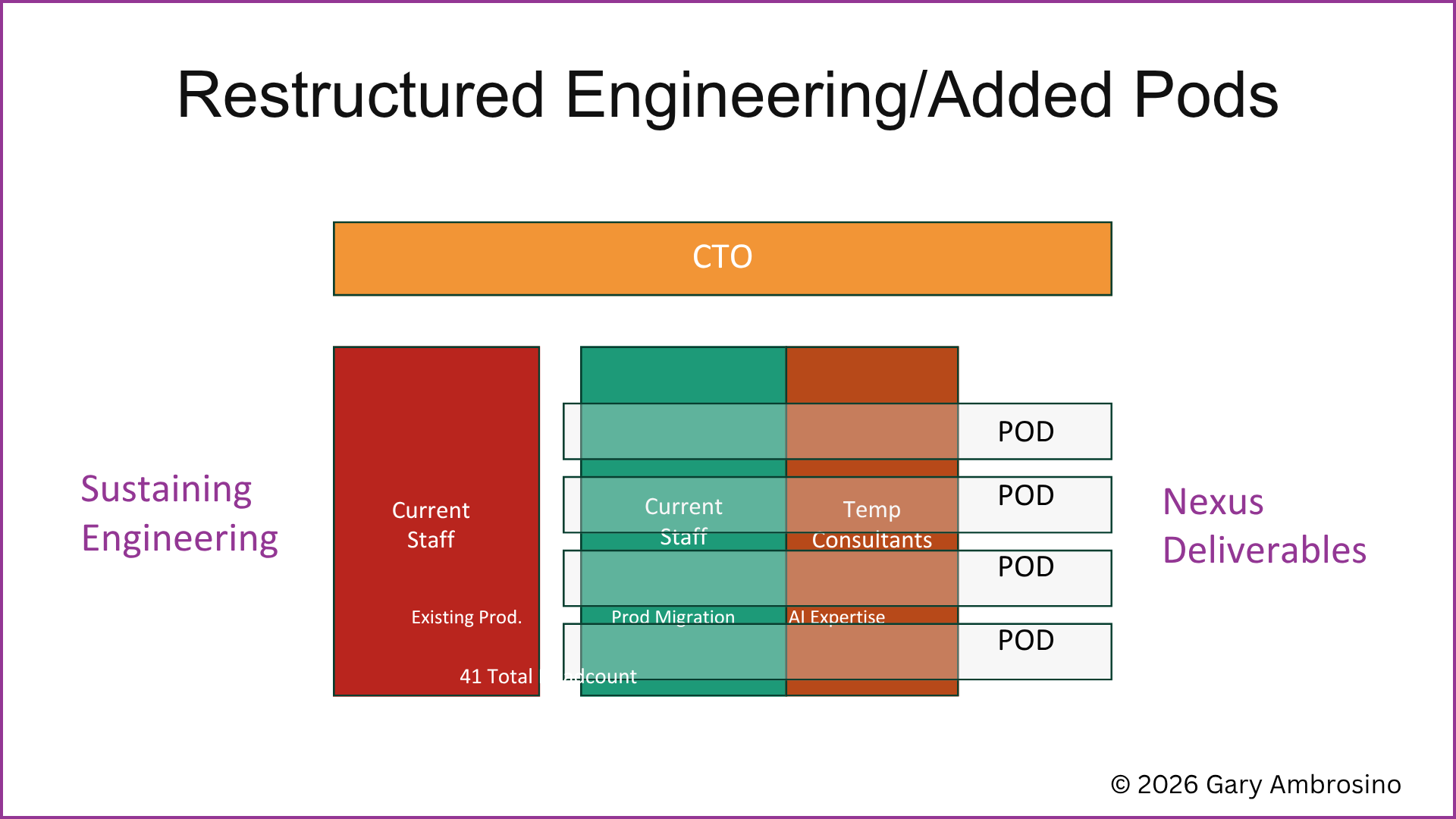
  • One of the most effective ways to accomplish this is by restructuring engineering departments into flexible, cross functional delivery pods. 
  • Under this model, engineers maintain a functional home for their craft, standards, and professional growth, but they deploy into specific, cross functional pods to execute deliverables. 
  • This dual structure allows the organization to dedicate a protected group to maintaining existing product revenue and keeping the lights on while the new delivery pods simultaneously build the AI native platform at an accelerated pace.


The top three actions for CEO’s to take right now:

  1. Uncover your company’s AI Alpha.
    What unique and valuable information do you have in your company’s data corpus and knowledge about your customer?Create a defensible competitive moat by building AI around that specific knowledge.
  2. Review the cost and build model.
    Evaluate open-source models, your token economics and your team structure to understand what it will cost to operate as an AI-native company without destroying your gross margins.
  3. Align your stakeholders.
    Your board, your investors, your executive team and your company must understand and align on what an AI-native transformation requires. This includes securing concrete agreement on the funding, divestitures, and team restructuring necessary to execute the transition.

The transition from legacy software to a fully AI native platform is no longer a future theoretical exercise. It is a present day mandate for protecting and multiplying your enterprise value. 

Incremental updates and simply decorating your current product with basic chat interfaces will not build a durable competitive moat. 

By stepping to the front to lead, identifying your unique AI Alpha, rigorously managing your tokenomics, and flattening your organization into agile delivery pods, you can separate your company from the pack and capture a premium valuation. 

The window for this transformation is actively closing, and the leaders who take decisive action right now will be the ones who secure their market position and drive sustained growth for the future.


Connect With Us…

To learn how we support CEOs directly and through investor portfolio services:

  • High-Growth CEO Forum®
  • High-Growth CEO Coaching™
  • Planning for Growth™ — Building the Profit Spiral®
  • Building the Executive Team as Leaders of Growth®
  • CEO Workshops
  • Investor & Incubator Programs/Workshops

Visit High-Growth CEO to learn more.