HGCPosts

The Race Towards AI Adoption. What Kind of “AI CEO Captain” Are You? Why Does it Matter?

Navigating AI requires close attention to FOUR of our TEN CEO Roles: Deliver Winning, Innovative, ...

How Successful CEOs Lead Today: The Ten Roles That Drive Alignment, Execution, and Sustainable Growth

The CEO role has always been demanding, but the expectations of today's leaders are fundamentally ...

CEO Outlook 2025: Navigating Today’s Economic Climate with Resilience and Agility

CEOs currently need to lead through a lot of chaos and confusion. Rising costs, slower ...

Building a Great Board Dynamic and Productive Board Meetings

Every CEO and their investors know how important this is.  In some companies, the relationship ...

Introducing the High-Growth CEO Blog

We’re here because we truly understand and want to help you on your CEO journey ...

Navigating AI requires close attention to FOUR of our TEN CEO Roles: Deliver Winning, Innovative, Timely Products and Services | Lead the Company Through Change and Transformation | Live Your Core Leadership Principles and Serve as Chief of Culture, Communication, and Organization

Do not be lulled by the placid race above! The AI tempest has made landfall. For tech CEOs, the window for getting ahead of this is not measured in months. It is measured in weeks. The question is no longer whether AI will reshape your company’s destiny. It will. The question is whether you as the CEO are going to steer that reshaping from the front and have the courage to move forward quickly in the face of huge uncertainty!

AI will quickly stop being novel. What is window-dressing today will be table stakes tomorrow. The question for every CEO right now is: what will your defensibility be once AI is no longer unique? That question needs an answer, and it needs one now. This is not a technology conversation. It is a leadership one. Only the CEO can drive this. How you drive it is pivotal to your company’s success.

And, please also remember that no matter where you are on the AI adoption curve model it is most important to live your core value principles and model your company’s culture drivers. Be kind, be transparent, be honest, and be brave. This change is difficult and stressful for everyone in the ecosystem you lead!


Special thanks to long-time High-Growth CEO Forum® member Gary Ambrosino for contributing his insights to this post.


Critical AI Trends

AI Fluidity
AI is becoming a fluid, ubiquitous element across all business operations rather than a standalone tool – a presence that permeates every part of a business’s workflow and the entire operational landscape.

AI as a Profitability Moat
AI must be mapped out into a program that creates a defensible moat and drives widespread profitability.

Premium Valuation through AI Story
Investing in a forward-looking AI narrative is critical for positioning a company for premium valuation.

Agentic Workflows for Productivity
Re-platforming to include agentic workflows allows for massive productivity gains and cost reduction.

Next Generation AI Architecture
Transitioning from traditional software stacks to next-generation AI architectures is required.


What Kind of CEO Are You – AI Firebrand, AI Middler, or AI Laggard?  

Your Company’s Course Will Depend on the Course You Chart!

The AI Firebrand CEO is the AI champion for the company, and everybody knows it!

  • A Player/Coach/Doer – no matter the company size and stage, the Firebrand is personally immersed in using AI tools.
  • Works alongside the team – does not just direct from above. They pull their team forward and don’t wait for their team to catch up!
  • Key executives, especially technology leaders, are required to spend weeks learning and using AI!
  • The Firebrand CEO understands how large language models (LLMs) work, and how data and LLMs interact. 
  • They know what you mean when you ask how they organize their data corpus. And they understand that the value is not in the LLM itself but in the harness you build around it.
  • AI Native: They are working to re-architecting products to be “AI Native.” Not simply to add a chatbot interface on top of an existing system.

“The key is engaging AI as a human resource.   At a minimum – you have to learn to scope a task, set goals, write prompts, skills, and behaviors just like you give an assignment to a team member. And importantly give them the set of information they should reference for the task.” — Gary Ambrosino

  • AI Firebrand CEOs are the ones investors ask to showcase their AI experience across portfolio companies and whose expertise is in high demand from their CEO peers.

Result: They are moving forward at lightning speed, figuring out how to fund and staff the technical transformations, thinking about required team and company re-organizations and staying laser focused on building customer value and true competitive moats!


The AI Middler CEO: The Middler CEO is making a true effort and assumes they are doing enough. And maybe they are?  Depending on their desired outcome.

  • They understand roughly what 700 million other ChatGPT users understand about interacting with AI.
  • They have connected their Google Drive to Claude and are trying some stuff.
  • The Middler encourages their team to “adopt AI somewhere somehow.”
  • They may use hiring as a proxy for progress and say to themselves, “I need to bring in someone who knows how to do this.” This response substitutes a search process for the CEO’s own immersion, and three months of recruiting puts you three months further behind your competitor who went first.
  • They look for productivity by gating new hires based on AI replacement criteria.
  • They plan to or may have added some AI positioning to the website. 
  • They assume they can “AI-decorate” a product and achieve competitive advantage from it. They think it will increase valuation and create a durable competitive moat. On all three counts, they are wrong:
    • AI decoration, placing a familiar chat interface on top of existing functionality without fundamentally rebuilding the underlying architecture, does not deliver AI-native valuations.
    • It may buy time, but it does not build defensibility. 
    • As one HGCF member put it: “decorating a product with AI may give you a temporary competitive advantage, but it will not be durable.”

Result: The Middler is not doomed. If budget constraints or investor limitations make a full product re-architecture impossible right now, getting to Middler could still be a meaningful outcome. It avoids valuation disaster. The goal for an investor-backed company that cannot yet fund a full rebuild is not to fail at being a Firebrand. It is to succeed at being a Middler.


The AI Laggard CEO: The Laggard makes excuses that their industry, product, or operations are not ripe for AI. 

  • They delegate whatever adoption happens to a few executives who seem to get it. There is no plan. No time set aside. No personal exploration.
  • The Laggard CEO has not identified their core defensible business advantage. This is extremely dangerous In a world where AI can replicate features quickly and where customer relationships are no longer the moat they once were.

Result: This is at your peril especially if your business is easy to replicate using AI technology, and you have not built a defensive moat. There is an extremely narrow exception – if you are in a super niche with zero competition and genuinely no credible path for AI to disrupt your market, you may be able to stay here. But that describes perhaps three percent of companies?


The Valuation Stakes Are Already Set

This is not a future scenario. The die is already being cast. Investor expectations around AI adoption are bifurcating valuations in real time. The Firebrand is commanding 10 to 20 times or more in revenue multiples. The Middler lands somewhere between one and three times. The Laggard risks getting 20 to 50 cents on the dollar.

In private equity portfolios especially, many companies avoided write-downs in early 2025. That grace period will not last another year. The CEOs who are still treating AI as a “wait and see” initiative are making a valuation decision right now, even if they do not realize it. VC funding for non-native AI companies has ground to a halt and CEOs are struggling to become breakeven asap.  Time is not on anyone’s side!

What distinguishes AI-decorated products from AI-native products matters acutely here. A chatbot layered on top of existing data retrieval is not AI in any meaningful sense that investors are rewarding. The distinction is architectural. AI-native means the product has been rebuilt from the inside out, with data, process, and decision logic encoded into AI intelligence rather than hardcoded into a fixed SaaS structure.


How to Move Forward: From Laggard or Middler to Firebrand

Step One: Immerse Yourself, No Excuses

The first move is non-negotiable. The CEO must personally use AI. Not delegate learning to a team. Not commission a report. Sit down with the tools, build something small, and try to solve a real business problem. The shift from asking your team to adopt something you have not experienced yourself to leading from personal fluency is the difference between a mandate that lands and one that does not.

The resources are everywhere and many are free. Log into Claude and ask it to create a beginner tutorial on prompt engineering with exercises. LinkedIn Learning offers comprehensive AI coursework for roughly $300 per year. There is no legitimate excuse for a college-educated CEO not to find a path into this material.

Block the time. A Saturday morning. A holiday break used as an AI sprint. If you are not willing to make this investment, the conversation with your team will never carry the weight it needs to.

“If you are a CEO that does not enjoy learning and does not want to make the investment to learn this, you should retire. Because you are done.” — Gary Ambrosino

Step Two: Understand What Your Defensible Advantage Actually Is

Once you have personal fluency, the strategic work begins. You are now in a fluid world. A SaaS product crystallizes your market knowledge into a fixed structure. AI changes that entirely. Your competitive advantage now lives in knowledge repositories, unique data, and proprietary process understanding, and only if that knowledge is encoded into AI intelligence.

This requires a genuine strategic analysis:

  • What does your company know that no one else knows?
  • What data do you have access to that is genuinely unique?
  • What process and understanding have you built that can be encoded, not just described?

These are the questions that separate the companies that will maintain valuation and a growth journey from those that will not.

Step Three: Build Courage, Set the Pace, Lead the Team, Be Decisive, Be Transparent

After personal fluency and strategic clarity comes the hardest part: being the change agent in the face of uncertainty. AI allows you to move and pivot faster than you ever could before. A product that would have taken a year to develop can be rebuilt in weeks. That speed advantage only accrues to the CEO who is willing to go first without waiting for certainty.

Once you have built something yourself, bring that experience directly to your technology leader. The conversation changes entirely when you can point to exactly what is possible and exactly what pace is acceptable. Give your engineering team a deadline, not a framework. Ask for a concrete AI strategy with owners and timelines, not a slide deck.

Then give your entire team the time and permission to experiment. If you have not already given your function leaders a defined window to develop an AI strategy for their area, set that expectation now. The culture of adoption spreads fastest when the CEO models the behavior first.

When your team sees you willing to be a beginner, willing to invest your own time, willing to look uninformed in service of getting informed, it gives the rest of the organization permission to do the same.


The Self-Assessment Every Tech CEO Needs Right Now

For tech CEOs, this is the most important set of questions on the table right now. Not where you want to be on AI. Where you actually are.

  1. Have you personally used AI tools for a real business task in the past 30 days? 
  2. Has your technology leader been given a clear mandate and a deadline? 
  3. Have your function leaders been asked to develop an AI strategy for their area? 
  4. Has your team been given structured time to experiment, not just encouraged to explore?

If the answer to any of these is no, the gap between you and the CEOs gaining the most ground is already wider than it needs to be. That gap can be closed quickly. But only if the CEO goes first, and does so quickly! 


The Question Is No Longer Whether. It Is Who Goes First.

The CEOs in our High-Growth CEO Forums® gaining the most ground on AI are not the most technical. They are the most willing: willing to block the time, willing to sit with an unfamiliar tool, willing to build something small and imperfect and learn from it.

Great CEOs do not wait to be convinced. They go find out.


Connect With Us…

To learn how we support CEOs directly and through investor portfolio services:

  • High-Growth CEO Forum®
  • High-Growth CEO Coaching™
  • Planning for Growth™ — Building the Profit Spiral®
  • Building the Executive Team as Leaders of Growth®
  • CEO Workshops
  • Investor & Incubator Programs/Workshops

Visit High-Growth CEO to learn more.

This is the first in our blog series examining the Ten CEO Roles through the lens of 30 years of experience working with high-tech, high-growth, investor-backed CEOs. Each post will bring timely insights from our High-Growth CEO Forums® (HGCFs), Building the Profit Spiral® planning processes, and CEO coaching. Through our Ten CEO Roles Survey, found at the end of every post, we invite you to share your current experiences which will be rolled into an anonymous update on a regular basis. Thank you for participating in our High-Growth CEO conversation!


How Successful CEOs Lead Today: The Ten Roles That Drive Alignment, Execution, and Sustainable Growth

The CEO role has always been demanding, but today’s expectations of today’s leaders are fundamentally different. Investor-backed CEOs are being asked to operate at multiple altitudes at once, navigate constant change, and lead organizations that are growing, transforming, and stretching faster than ever before. At the same time, they are expected to stay grounded, think clearly, build aligned teams, and make high-quality decisions with imperfect information.

One theme has become unmistakable. Great CEOs are not defined by personal heroics or sheer effort. They are defined by how well they understand and execute the core responsibilities of the role. These responsibilities are predictable, learnable, and repeatable. When leaders master them, companies accelerate. When leaders neglect them, growth becomes harder, execution becomes inconsistent, and complexity starts to win.

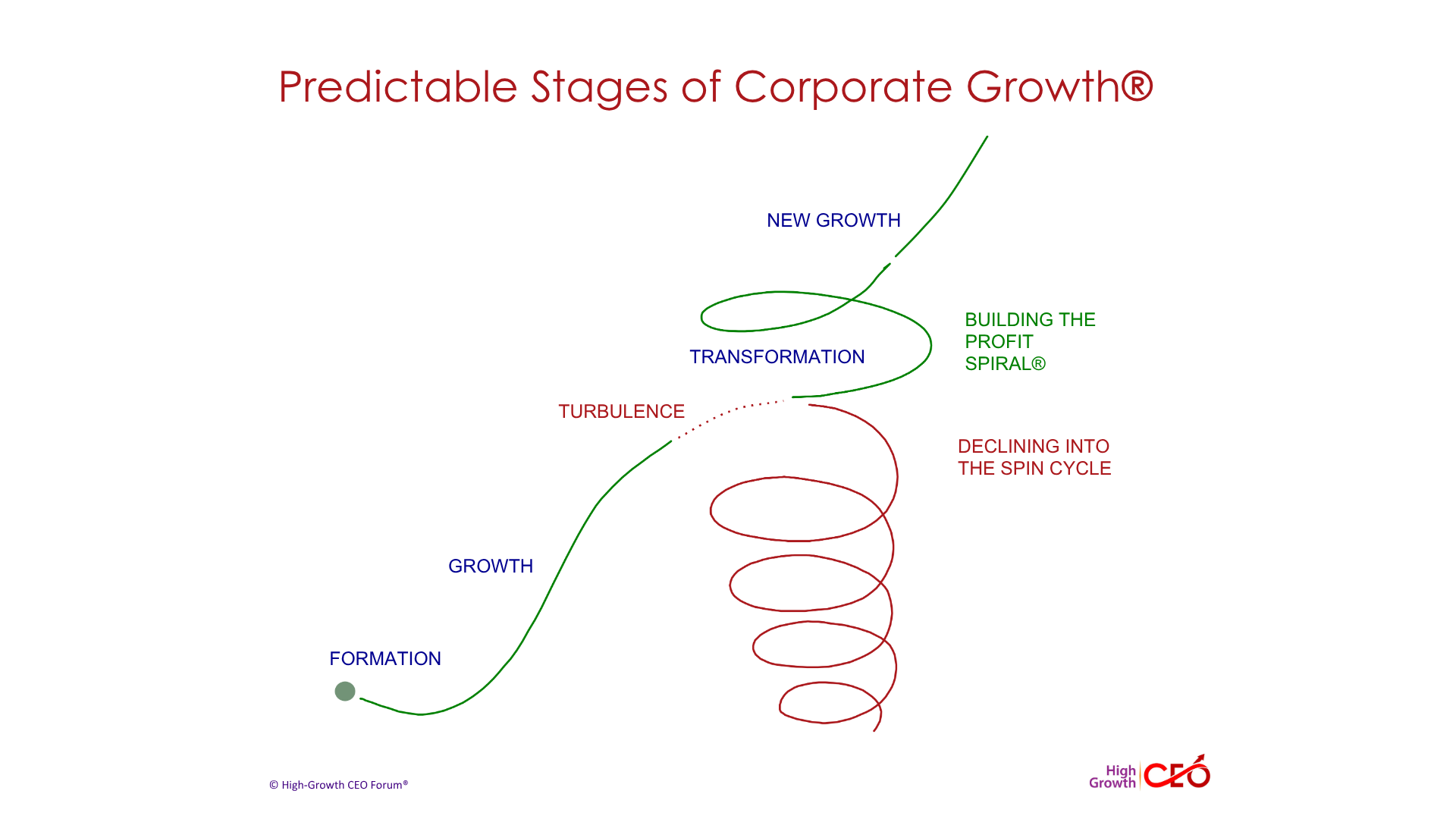
The High-Growth CEO Roles Framework (HGCRF) outlines the essential responsibilities every CEO must understand to lead a company through the Predictable Stages of Corporate Growth®.

The HGCRF applies whether you are a first-time founder or a multi-time CEO, and whether your company is expanding, transforming, or navigating turbulence.


The Ten CEO Roles Framework:

Over the course of this blog series we will explore each of the ten CEO roles and bring synthesized insights from the front lines of our client engagement. What we are seeing, what is working, and how difficult decisions are being made.

We are also asking you to weigh in. Which of these roles is requiring your most urgent attention right now? What is the one question you need answered to move forward? The pulse of what CEOs are experiencing in the real world is exactly what shapes this series, and your perspective matters.

One. You: Focus on your health and wellbeing. Embrace learning and role evolution

Two. Values: Live your core leadership principles. Serve as chief of culture, communication, and organization

Three. Customer/Product: Deliver winning, innovative, timely products and relevant services to carefully selected customers and markets — with increasingly predictable revenue results over time

Four. Team: Continuously evolve a high-performing executive team — mentoring, hiring and firing with appropriate timing related to company growth stage

Five. Alignment: Deliver your mission/core purpose and two- to three-year envisioned future state

Six. Execution: Ensure delivery of a shared multi-year company roadmap by developing, evolving and leading an annual operating system

Seven. Resource Stewardship: Fundraise for growth and/or build EBITDA. Never run out of cash

Eight. Transformation: Lead the company through change and transformation

Nine. Board: Manage the board of directors — investors, independents and other advisors

Ten. Market Ecosystem: Connect with CEOs of potential strategic partners and acquirers — years ahead of a potential tangible outcome

Use the HGCRF to Navigate Success!

The environment CEOs are operating in now is evolving at lightning speed. Markets move faster. AI is changing the game. Teams expect and need more clarity, transparency, and alignment. Execution requires cross-functional coordination. Technology is reshaping how organizations operate. And the emotional demands of the role have never been higher.

When CEOs effectively deliver on the HGCRF they:

  • Approach their role with structure
  • Treat leadership as a discipline imbued with their core values
  • Understand where to spend their time, how to elevate their thinking, and how to create alignment across the organization
  • Know which responsibilities belong to them and which belong to their team and how those responsibilities need to evolve
  • Lead from steadiness, not strain
  • Create stronger alignment, better decision-making, healthier executive teams, and a more resilient organization

As one of our clients states: “When I understand the role I need to play, everything else becomes easier. My team moves faster, decisions get clearer, and the company feels more aligned.”  

We Believe…

Great CEOs are not born. They develop through intention, reflection, practice, structure, and learning. They evolve to support the evolution of their companies. They learn to lead. Not by doing more, but by doing the right things at the right altitude.

These ten roles provide a foundation for clarity, focus, and high-impact leadership in a world where the demands on CEOs continue to grow.


Right now the top two critical roles identified by our clients are: 

  • Delivering winning, innovative and TIMELY products
  • Stewarding resources carefully

In subsequent posts we will apply learnings and discoveries about how to address current CEO challenges in executing these ten areas successfully.

Which two roles are most important for you to focus on right now? What is the one thing you need to do differently, or the one action you need to take to be most effective in those areas? Take a minute to weigh in below. 


Connect With Us…

To learn how we support CEOs directly and through investor portfolio services:

  • High-Growth CEO Forum®
  • High-Growth CEO Coaching™
  • Planning for Growth™ — Building the Profit Spiral®
  • Building the Executive Team as Leaders of Growth®
  • CEO Workshops
  • Investor & Incubator Programs/Workshops

Visit High-Growth CEO to learn more.

CEOs currently need to lead through a lot of chaos and confusion. Rising costs, slower customer decisions, and geopolitical uncertainty are creating real challenges. At the same time, rapid AI adoption is opening both new opportunities and fast growing competitive threats across market and fundraising landscapes.

To better understand how companies are experiencing and navigating these conditions, we asked CEOs in our High-Growth CEO Forums (HGCFs)  to share their recent reflections. Their perspectives, drawn from candid peer discussions, reveal a mix of resilience, cautious optimism, and sharpened focus on strategic priorities.

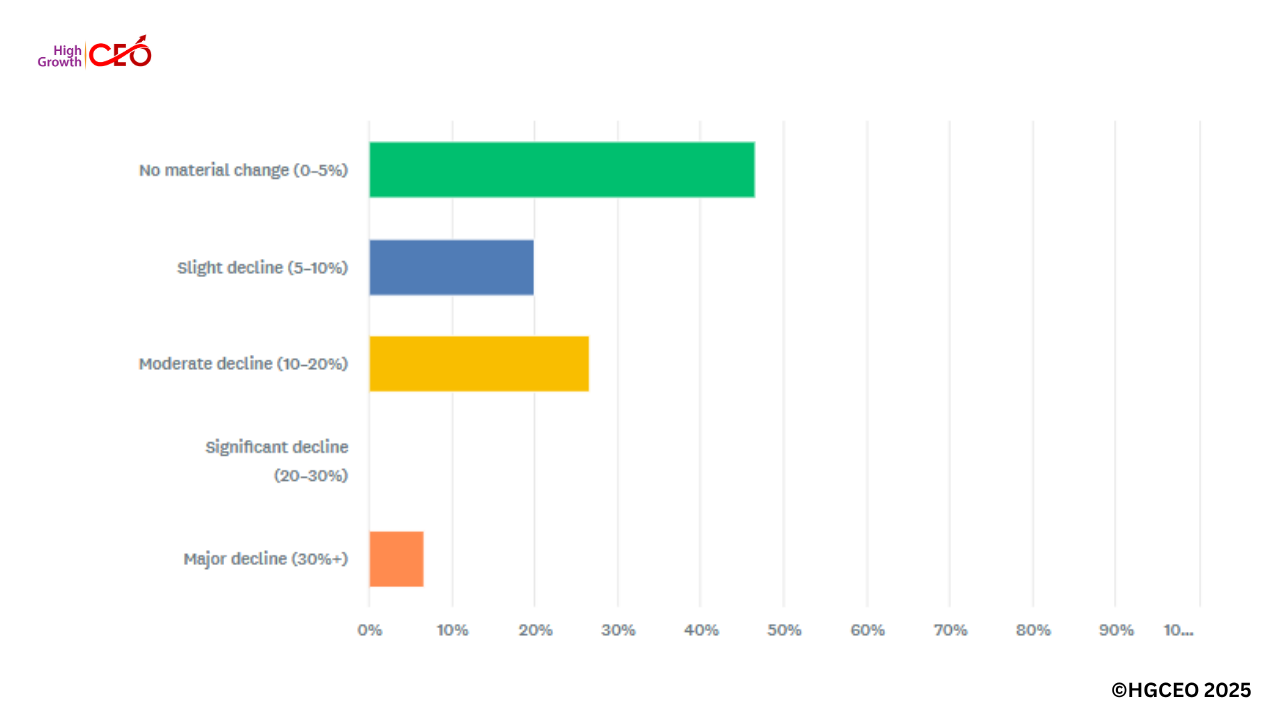
“Nearly half of CEOs reported no material change in recent revenue performance, while a quarter saw moderate declines.”


CEO Perspectives on Recent Performance

When asked how revenue and closed-won performance compared to forecast, CEOs reported a wide range of outcomes. Nearly half said they experienced little or no material change, a signal that steady demand and strong pipeline conversion remain possible in today’s market. At the same time, one in four experienced moderate declines, citing rising costs, delayed customer approvals, and shifting internal priorities as key reasons. A smaller, but significant, group reported major declines of 30 percent or more. For these CEOs, volatility is very real and often outside their direct control.

The qualitative reflections behind the numbers add important context. As one CEO put it, “The appetite is there, the approvals are just slower.” Another explained, “Internal bandwidth is now one of our biggest bottlenecks.” These perspectives underscore that while many CEOs are holding ground, others are fighting uphill battles against forces that include both market dynamics and internal constraints.


CEO Outlook for the Months Ahead

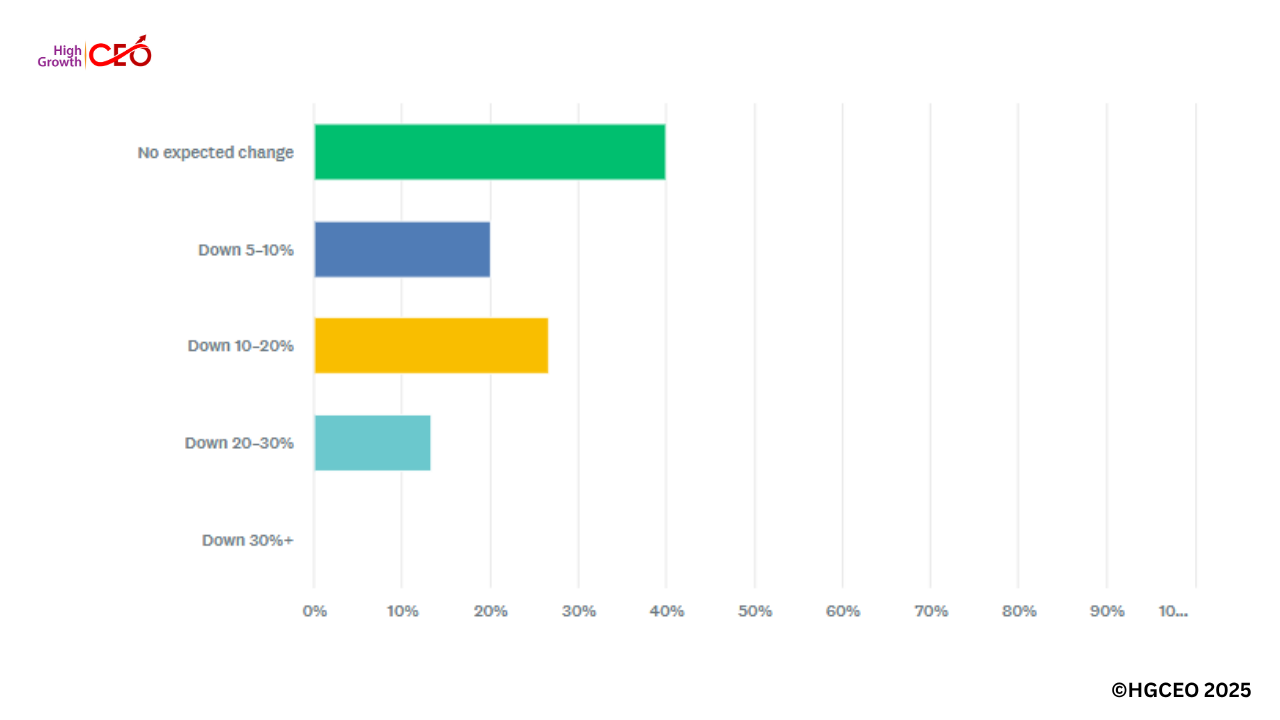
Looking forward, CEOs are preparing for the remainder of 2025 with a pragmatic lens. Roughly 40 percent expect no material change from their original forecasts, which suggests confidence in their positioning and resilience in their industries. Another 40 percent expect performance to be down between 5 and 20 percent, reflecting continued caution and a recognition that external conditions may weaken pipelines even if demand holds. A smaller group anticipates sharper declines of more than 20 percent and are bracing their companies for more aggressive cost discipline.

To illustrate this, the survey data shows a nearly even split: 40 percent holding steady, 40 percent expecting modest declines, and 20 percent bracing for significant headwinds.

“CEO outlook for the remainder of 2025 reflects pragmatism: 40% expect steady performance, while another 40% anticipate modest declines.”

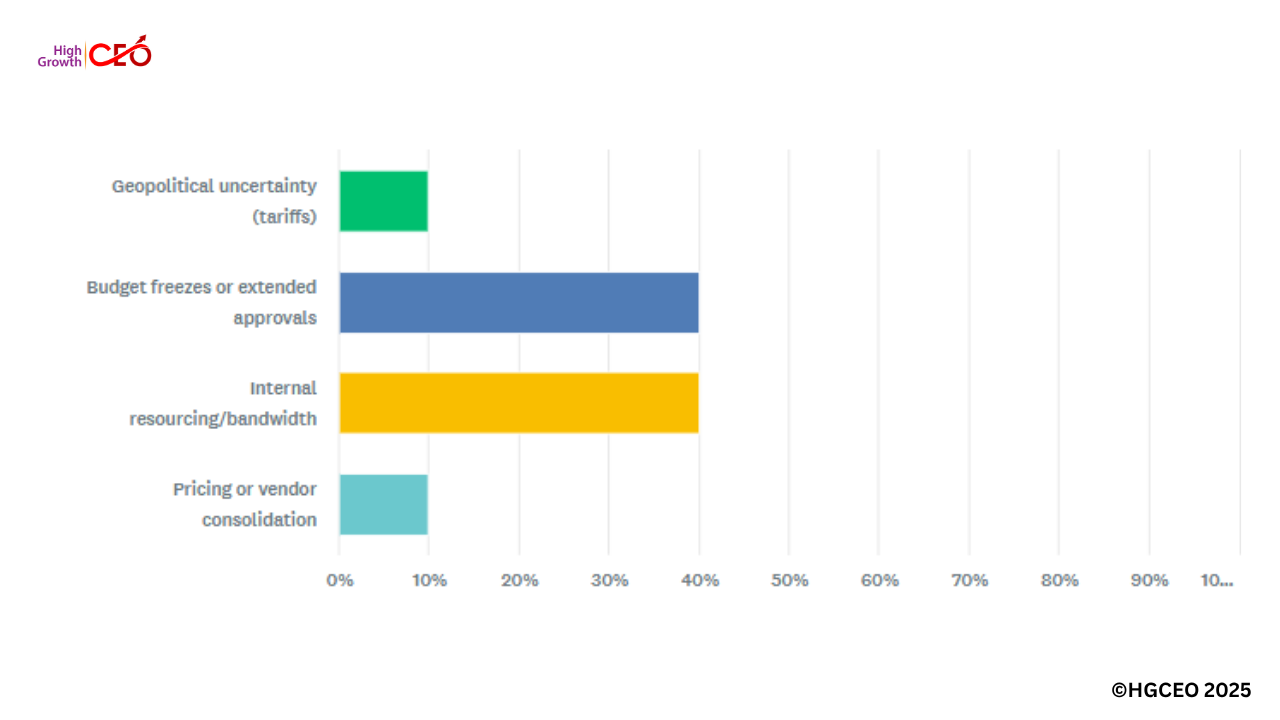
The underlying rationale for these expectations offers deeper insight. When asked what is driving this outlook, two factors stood out:

  1. Internal resourcing and bandwidth – CEOs are prioritizing where to place limited time and capital, often delaying lower-priority initiatives.
  2. Budget freezes and extended approvals – Even when appetite exists, approvals are slower, requiring CEOs to manage pipeline health more closely.

Together, these accounted for the majority of slowdown reasons cited.

“Budget freezes and internal bandwidth constraints were cited most often as reasons for slower cycles.”

Not every outlook was defensive. Several CEOs emphasized that technology, particularly AI, is creating measurable offsets. One remarked, “AI-driven efficiencies allowed our teams to close deals faster than expected,” illustrating how innovation is helping companies protect momentum even as macro conditions drag.


What is Driving Slowdowns?

When CEOs described what is slowing execution, three factors emerged most frequently. 

  1. Roughly 35 percent pointed to budget freezes as the leading barrier, noting that even well-qualified opportunities are being delayed until spending restrictions ease. 
  2. About a quarter highlighted extended approval cycles, with decisions getting caught in additional layers of review or, as one CEO described, “stuck in committee.” 
  3. Another 20 percent pointed to internal bandwidth constraints, acknowledging that stretched teams are forcing leaders to prioritize only the initiatives most critical to near-term growth. 

Taken together, these factors explain why even companies with strong pipelines are experiencing slower-than-expected sales cycles. As one CEO summarized, “We are still seeing opportunities, but the pace of execution is constrained in ways we have not experienced before.”


Where CEOs See Opportunities

Despite headwinds, CEOs are not standing still. Instead, they are identifying levers that create advantage in this environment. 

  1. AI adoption is leading the way. What was once experimental is now mainstream, and CEOs are reporting tangible results in shortened sales cycles, improved forecasting, and measurable efficiency gains across the organization. 
  2. Selective investment is another clear trend. CEOs are concentrating capital and talent on opportunities with the highest likelihood of revenue conversion, often shelving or delaying initiatives that do not have a clear payoff. 
  3. Finally, resilient sectors continue to stand out. Companies with strong product-market fit are maintaining momentum, and CEOs in these industries are leaning into customer demand to reinforce their position.

AI in particular is no longer optional. It is reshaping sales cycles and execution across industries, and the efficiency gains are proving too material to ignore. The broader theme is that even in a challenging climate, CEOs are finding ways to convert disruption into leverage. Those who can integrate AI, allocate capital with discipline, and double down on proven markets are positioned not just to survive but to gain ground.


What This Means for CEOs Right Now

The findings confirm what most CEOs are already living every day: leading a company in 2025 requires both confidence and caution. The CEOs who are thriving are those who stay agile, revisit pipeline health often, and leverage tools like AI to sharpen efficiency and execution. Just as importantly, they are communicating transparently to their Boards, investors, and employees about the realities of the environment.

The CEO role has always demanded resilience. In today’s climate, it demands even more discipline, speed of adjustment, the ability to find growth in unexpected places, and the capacity to lead the company through uncharted waters.


Share Your Perspective

The insights we have gathered reflect how some CEOs in our High-Growth CEO Forums are navigating today’s complex business climate. We now want to broaden the lens. We invite you to add your perspective through our short CEO Outlook Survey. It takes only a few minutes, is completely anonymous, and will remain open until October 30.

We will publish the aggregated results on LinkedIn in early November so you can compare your outlook with that of your peers.

👉 Take the CEO Outlook Survey

Every CEO and their investors know how important this is.  In some companies, the relationship between CEO and Board is a model of trust, efficiency, and focus on critical growth issues. In other companies, CEOs and their Boards unfortunately seem to thrash around and struggle to find the right dynamic.
Building a great board dynamic is not exclusively about board meetings.  Good relationship-building takes place with 1:1 connections. But the primary and official vehicle are your formal board meetings. CEOs need to be on top of their game in this arena. In our High-Growth CEO Peer Forums, this CEO Member Challenge comes up frequently, in various flavors and forms. Here is some guidance from HGCF members for creating and delivering great Board meetings and relationships.
ESTABLISH CLARITYBe very clear on the essential role of everyone in the room:
  1. Board: financial investment, governance, compensation, pattern detection, selective input on the right strategic topics, help with fundraising, hiring, connections to partners
  2. CEO and Leadership Team: forecast, execute, report results, give customer/ market/competitive flavor, frame the right key issues, lead the discussion on recommendations and solutions
  3. Make sure critical Board roles are in place – don’t forget to fill the independent seat(s) and the compensation committee
CREATE CONSISTENCY – Have a standard approach, rhythm, and template:
  1. Create the appropriate cadence (maximum of monthly, minimum of quarterly) and calendar the meetings at the beginning of each fiscal year
  2. Send materials ahead of time
  3. At every meeting review financials, emphasize key sales updates and product development highlights
  4. Hand-pick and frame 1-3 key topics for each meeting for carefully structured Board input. Focus the presentation on just these items (put all the rest in a back-up appendix)
STAY FOCUSED – The CEO sets the expectations, tone and frames the discussion:
  1. Avoid the dreaded free-for-all by staying laser focused on the discussion at hand.  Do not get side-tracked. Boards will talk and opine on anything… but their role is to approve (or not)
  2. Don’t get trapped into making decisions at the Board meeting if it’s not warranted.  It’s perfectly reasonable to say “we acknowledge and appreciate the input…we’ll work on it and get back to you” and then make a point of doing exactly that
  3. Help the Board help you by giving them meaningful projects and leveraging their expertise.
BUILD TRUST & TRANSPARENCY: Be extra, extra careful about setting the Board’s expectations about revenue and other critical metrics. Missing the plan of record erodes investor confidence quickly and missing it repeatedly can lead to a CEO change:
  1. Remember, the CEO knows the company better than anyone else so don’t agree to plans you don’t believe in – even if you feel pressured to do so
  2. Sometimes CEOs need to temper their own optimism to avoid adopting hopeful versus realistic, negative scenario tested plans
  3. When big macro trends like pandemics, recessions, wars and bank meltdowns cause unforeseeable disruptions, or other major negative forces appear, CEOs should change the plan asap with feedback from the Board
  4. Be precise about communicating revenue or growth that is one-off and not repeatable, or a result of timing quirks. Otherwise you’ll be explaining these endlessly in the future.
  5. Early stage companies should understand, share and measure the metrics that indicate successful progress and learning – which may not be revenue
CREATE TEAM VISIBILITY & ACCOUNTABILITY: Involve your key team members in Board meetings where and when appropriate:
  1. It gives the Board visibility into your team
  2. It’s good team member development, recognition, and importantly adds to their personal accountability
  3. Coach your team members to help them develop their Board presentation skills. Be crystal clear about their role in the meeting. Make sure they understand how to manage Board questions, and how to keep their input focused and aligned with the company’s goals
NO SURPRISES – EVER! Do not wait for the regularly scheduled Board meeting to share bad news – communicate it at once. Good news should travel fast, but bad news should travel faster!